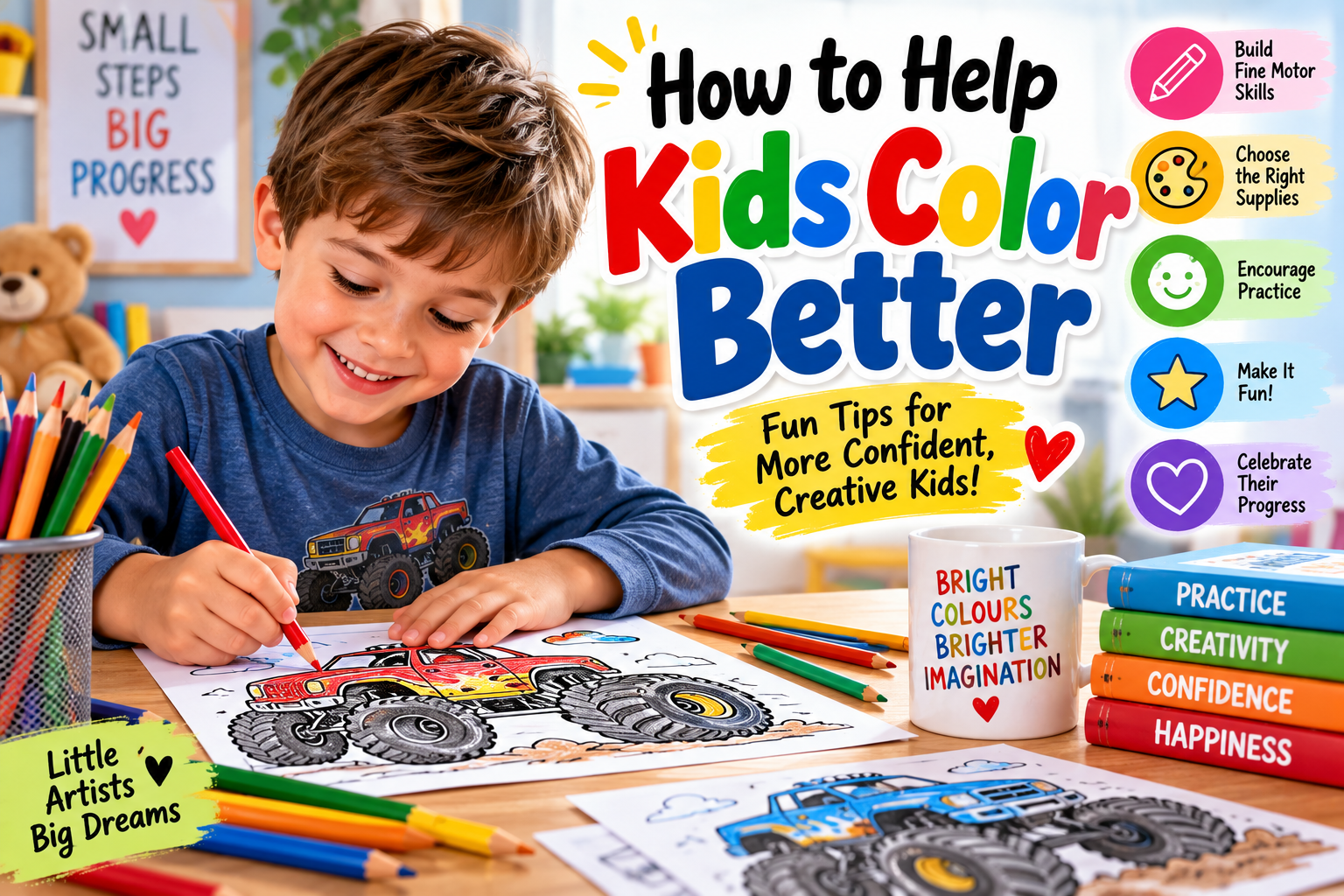
Coloring looks wonderfully simple from an adult’s point of view: choose a crayon, pick a picture and start filling in the spaces. For a young child, however, there is quite a lot happening at once. They are deciding which colors to use, controlling the crayon, watching the outlines and figuring out how much pressure to apply—all while trying to create a picture they like.
That is why children’s early coloring pages can be wonderfully unpredictable. A dinosaur may be purple, the sun might be green, and a few enthusiastic crayon strokes may escape halfway across the page.
And that’s perfectly fine.
Children don’t need to produce perfectly colored pictures to enjoy or benefit from the activity. What parents can do is make coloring easier to approach, gradually introduce useful techniques and—most importantly—keep the experience enjoyable.
Here are 10 simple coloring tips you can use at home.
1. Start With Large, Simple Coloring Pictures
A child’s coloring page should match their current ability. Beginners can easily become frustrated when presented with pictures containing dozens of tiny sections, narrow spaces and complicated patterns.
Start with illustrations that have large open areas, bold outlines and relatively few details. A big smiling dinosaur, simple rocket or chunky monster truck gives a child plenty of room to move a crayon without constantly crossing an outline.
As their control improves, gradually introduce smaller spaces and more detailed illustrations. You can think of coloring pages almost like levels in a game: start easy and increase the challenge as your child becomes more confident.
Try This at Home
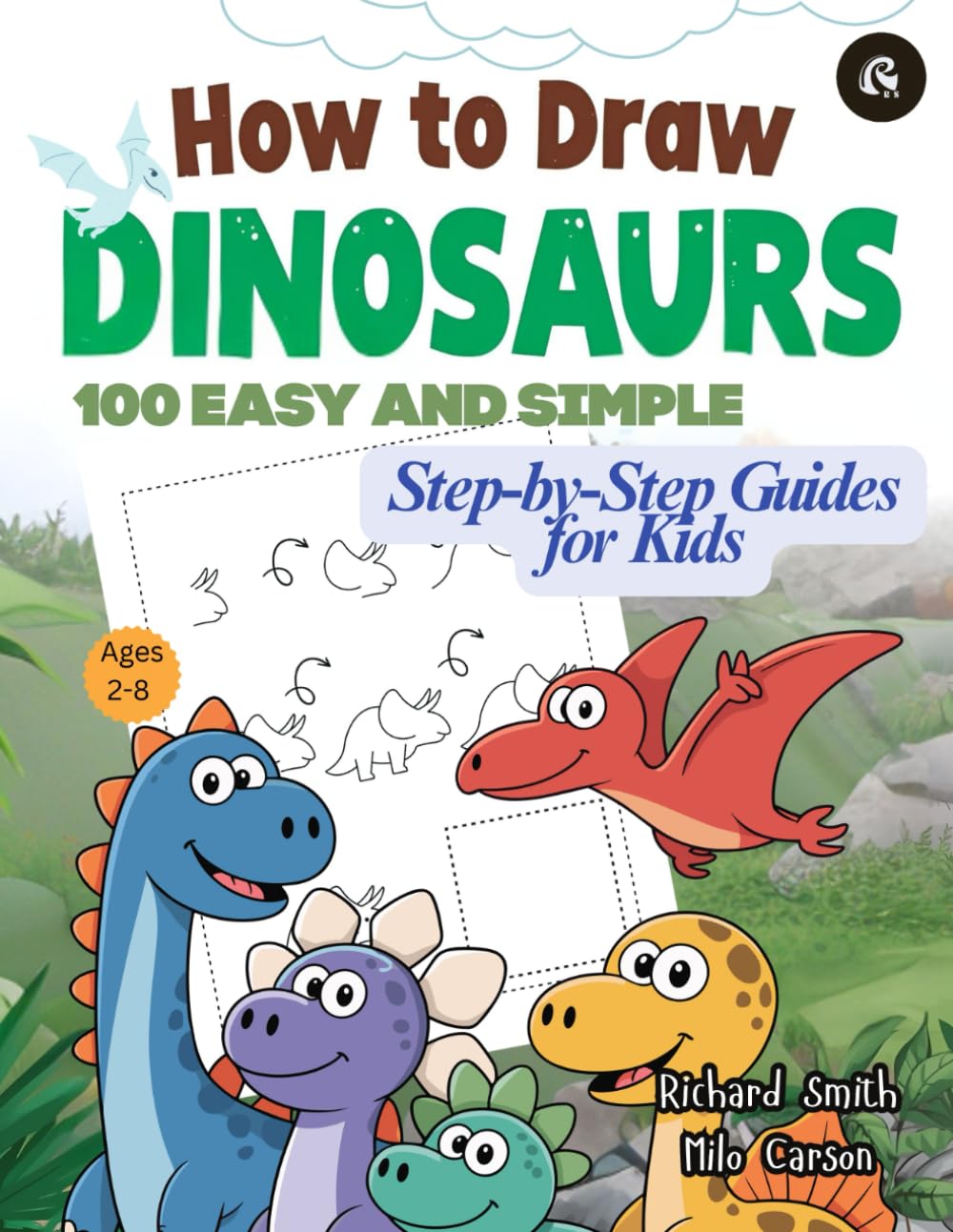
Give your child two pictures from the same theme—perhaps a simple dinosaur and a more detailed dinosaur scene. Let them complete the easier one first, then ask if they are ready for the “next level.”
It turns increasing difficulty into an achievement rather than a test.
From the bookshelf
Recommended books
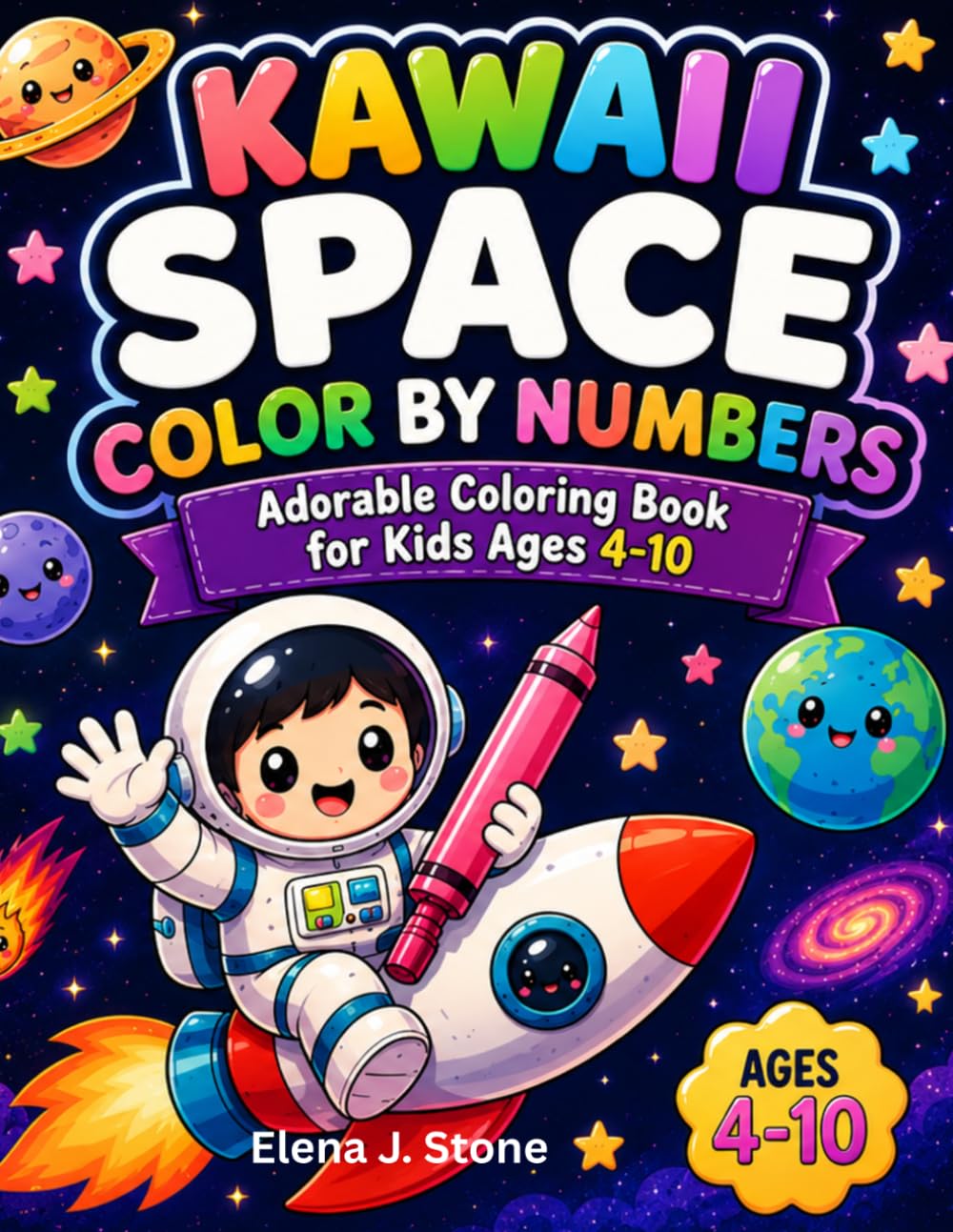
Continue the fun with one of these activity books.
2. Choose Coloring Tools That Are Easy to Control
The right coloring tools can make the activity much more comfortable. Very young children may find chunky crayons easier to hold, while older children who have developed more control may enjoy regular crayons, colored pencils or washable markers.
There isn’t one tool that every child must use. Crayons are forgiving and excellent for covering larger areas; colored pencils work well when pictures contain smaller details; markers produce strong colors but generally require more control because every stroke is immediately visible.
Let your child experiment with several options. Sometimes a child who seems uninterested in coloring simply hasn’t found a tool they particularly enjoy using.
You don’t need an enormous art box either. A manageable selection of good colors is often enough.
3. Encourage a Comfortable Grip Without Turning It Into a Lesson
Parents understandably want children to learn how to hold pencils and crayons properly. The problem begins when every few seconds of coloring are interrupted with another correction.
“Move your fingers.”
“Hold it like this.”
“Not that way.”
After a while, the child isn’t thinking about their dinosaur anymore. They’re thinking about how they’re apparently holding the crayon incorrectly.
Instead, demonstrate naturally. Sit beside your child and color something yourself so they can see how you hold and move the crayon. Choose tools that are comfortable for their hands and give them opportunities to practice.
Coloring can contribute to the hand control children use in many everyday activities, but recreational coloring doesn’t need to feel like handwriting class.
4. Encourage Smaller, Slower Movements
Some children attack a coloring page at impressive speed. A few enormous strokes cover the dinosaur, the tree and approximately half the sky—and they’re finished.
Simply saying “color more neatly” doesn’t tell a child what to do differently.
Instead, show them how smaller movements can help when they reach the edge of a picture. They can make broader strokes across a large open area and then slow down when working near an outline or small detail.
You can even turn it into a game:
The Slow-Motion Challenge: Choose one small part of the picture—a dinosaur’s tail, a truck wheel or a rocket window. See how slowly and carefully your child can color that one section.
Only make the challenge apply to a small area. The entire picture doesn’t need to become a test of patience.
5. Try the Border-First Coloring Trick
For children who are beginning to work on staying within outlines, one simple technique is to color around the inside edge of a shape before filling the middle.
Draw a large circle on a blank piece of paper and demonstrate. Slowly color around the inner edge, creating a colored border, then fill the large middle section with more relaxed strokes.
Once the idea makes sense, try a square, heart or star before using the technique on an actual coloring page.
A useful way to explain it to children is to imagine that they are building a little fence around the area they want to color. The middle can then be filled more freely.
It won’t instantly produce perfect coloring—and it isn’t supposed to. It simply gives children another technique to experiment with.
6. Give Children Freedom to Choose Their Colors
There is a strong temptation to correct unrealistic colors. Grass should be green, elephants should be grey and surely nobody has ever encountered a pink Tyrannosaurus rex with blue spots.
But coloring is also an opportunity for imagination.
If the activity isn’t specifically teaching realistic colors, allow children to make unusual choices. Rather than saying, “Dinosaurs weren’t pink,” try asking, “How did this dinosaur become pink?”
You may suddenly discover that it lives on a candy planet, eats strawberry leaves and turns invisible every Tuesday.
That conversation transforms a coloring page into a storytelling activity.
You can still teach children about real-world colors when appropriate, but creativity doesn’t have to disappear in the process. Sometimes the purple cow is the most interesting thing on the page.
7. Introduce Color-by-Number When They’re Ready
Ordinary coloring allows children to choose their own colors. Color-by-number adds a little structure by asking them to match numbers with a color key.
For example, a simple key might show 1 = blue, 2 = yellow, 3 = green and 4 = purple. The child finds each numbered space, checks the key and applies the corresponding color.
This creates a fun sequence:
Find the number → match the color → color the space → reveal the picture.
For beginners, choose pages with only a few numbers and large coloring areas. More complicated designs can come later.
You can also make the activity more playful by turning it into a number hunt. Ask your child to find every number 2 before coloring any of them, then move on to another number.
The finished picture provides a satisfying reward because children gradually uncover an image while completing the activity.
8. Sit Down and Color Together Occasionally
Giving children coloring materials is useful. Sitting down and joining them from time to time can make the activity even more engaging.
You could print two copies of the same page and create completely different versions. Alternatively, share one large picture: your child colors the dinosaur while you work on the background, or you color the rocket while they tackle the planets.
Children can observe techniques without receiving constant instructions. They see how you approach small areas, change direction near an outline or combine colors simply by watching you work.
There is also plenty of room for silliness. Let your child choose the colors you must use, or close your eyes and randomly select three crayons that both of you have to work with.
Just remember that this isn’t an adult coloring competition. Your beautifully shaded professional-looking dinosaur does not need to defeat a five-year-old’s green scribble-saurus.
9. Praise Progress, Effort and Creativity
If every response to a finished picture focuses on the marks outside the lines, children may start associating coloring with mistakes.
Look for something specific that genuinely deserves attention. Perhaps your child spent longer on the picture than usual, carefully completed a small section, tried a new technique or created an interesting combination of colors.
Instead of a generic “good job,” you might say:
“You took your time around those little stars.”
“I like how you chose three different colors for the rocket.”
“You finished the whole dinosaur today!”
That doesn’t mean pretending everything is perfect. It simply shifts the emphasis from producing flawless artwork to noticing improvement.
A slightly messy completed picture can represent far more useful practice than an immaculate picture a child became too frustrated to finish.
10. Keep Changing the Coloring Experience
Even children who enjoy coloring can become bored if every activity looks identical.
Change the theme. One day might be dinosaurs, another space, then ocean animals, farm animals, kawaii characters or monster trucks. Alternate ordinary coloring with color-by-number pages, simple drawing activities and creative challenges.
You can also introduce playful rules.
The Three-Color Challenge
Ask your child to choose—or randomly pick—only three crayons. Those are the only colors allowed for the entire picture.
Imagine a Christmas scene colored entirely in purple, orange and blue, or a monster truck that can only be green, pink and yellow.
Another day, reverse the activity and let the child choose your three colors.
Small variations like these keep coloring from becoming repetitive while encouraging children to make creative decisions.
What If My Child Keeps Coloring Outside the Lines?
This is probably one of the most familiar concerns parents have about children’s coloring, but staying inside the lines should not become the sole measure of success.
Children develop hand control gradually and at different rates. A child who currently uses broad strokes may later begin making smaller, more deliberate movements as they gain experience.
Rather than constantly correcting escaped strokes, adjust the difficulty of the activity. Start with large pictures and thick outlines, then gradually introduce medium-sized sections and finer details. The border-first technique can also be practiced occasionally without making it compulsory on every page.
If you have broader concerns about your child’s fine-motor development or their ability to manage everyday age-appropriate tasks, their teacher, pediatrician or another appropriately qualified professional can provide guidance based on the individual child.
For ordinary coloring time, however, progress is usually a much better goal than perfection.
Turn a Coloring Page Into More Than Coloring
A finished picture doesn’t necessarily mean the activity has ended.
Suppose your child has colored a dinosaur. Ask them to give it a name and decide what it eats. After coloring a monster truck, they could draw an obstacle for it to jump over. An ocean coloring page could become an I-Spy game: How many fish can you find? Which animal is closest to the treasure chest?
A space picture might inspire a completely different question:
“Where is this rocket going?”
Suddenly you have storytelling, observation and imagination growing out of one simple activity.
This is particularly useful when children have different interests. A child who doesn’t want to spend thirty minutes coloring may happily spend ten minutes coloring and another ten inventing a story about the picture.
Try a Simple 15-Minute Coloring Session
Long coloring sessions aren’t necessary, particularly for children who are just beginning to develop an interest in the activity.
For a short session, spend the first couple of minutes letting your child choose the picture and colors. Give them several minutes to color freely, then introduce one small challenge—perhaps carefully completing a wheel, star or other detailed section. Spend the final few minutes coloring together or talking about what they created.
If they want to continue, wonderful. If their attention has moved elsewhere, the picture can wait.
The aim is to make coloring something children are happy to return to.
Should Children Always Color Inside the Lines?
No.
There are times when staying within an outline is a useful skill to practice, particularly as children gain better control. But there should also be opportunities to scribble, draw, experiment and create without boundaries.
A blank sheet of paper offers something a coloring page cannot: complete freedom.
Try alternating between the two. A child might color a prepared dinosaur picture today and invent an entirely new dinosaur tomorrow.
Both activities have value, and they exercise creativity in different ways.
Better Coloring Should Still Be Fun
Helping a child become more confident at coloring doesn’t require turning the kitchen table into an art classroom.
Start with suitable pictures. Provide comfortable coloring tools. Demonstrate simple techniques, such as slowing down near borders or coloring the edge first. Introduce more detailed pages as confidence grows, and let children make plenty of their own creative decisions along the way.
Most importantly, don’t allow neatness to become more important than enjoyment.
A purple dinosaur with a few strokes outside the lines can still represent concentration, imagination and a child proudly saying:
“Look what I made!”
That’s a pretty good result from a box of crayons.
More Coloring Fun From Little Fun Lab
Once your child is comfortable with ordinary coloring, color-by-number activities can provide a fun next challenge by combining colors, numbers and a mystery picture to reveal.
Here at Little Fun Lab, we’ll be exploring both sides of coloring: creative freedom when children want to invent something completely their own, and structured activities such as color-by-number when they’re ready for a new challenge.
And, of course, there will always be room for the occasional purple dinosaur.