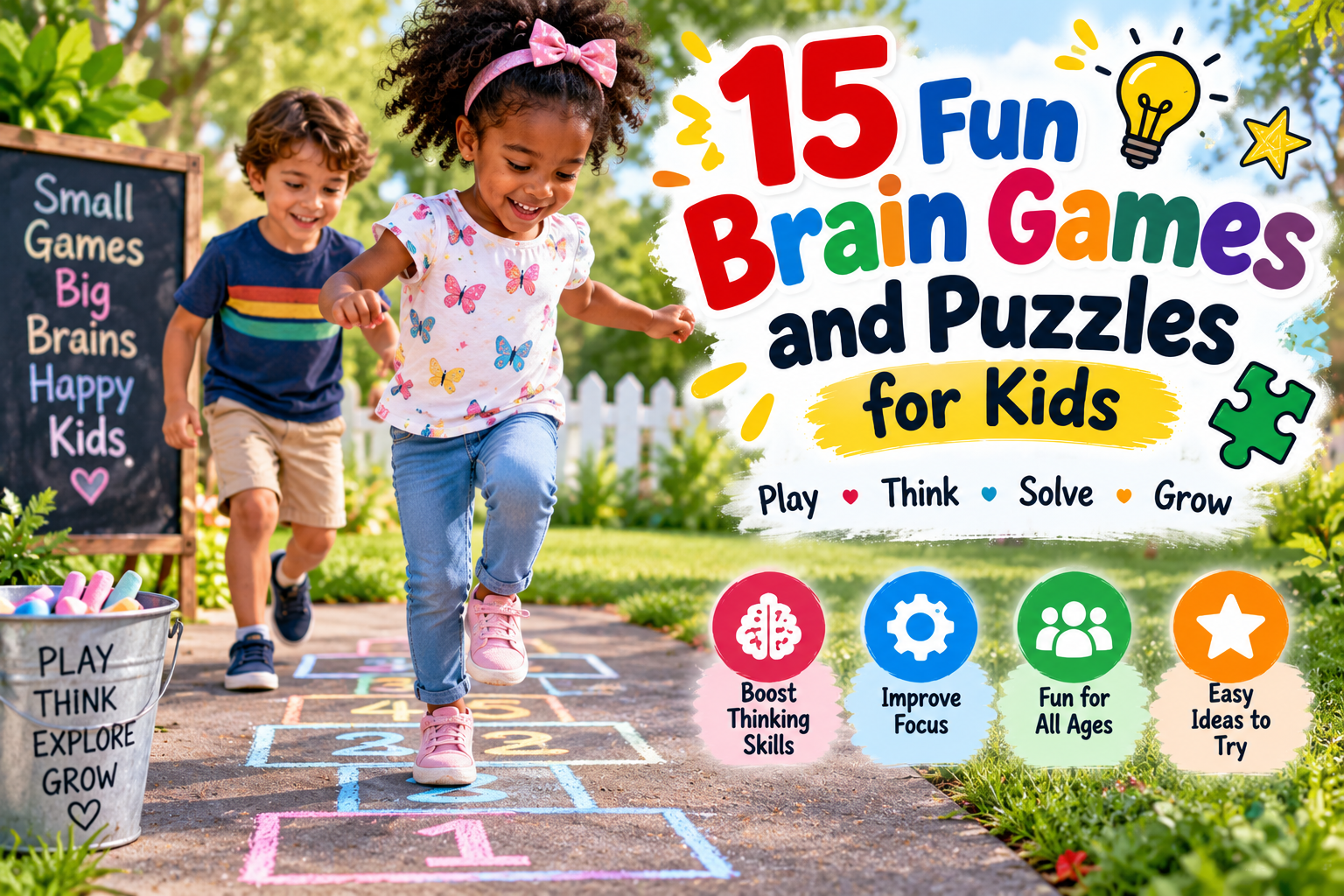
Mention the word puzzle to a child and you might get an enthusiastic response.
Mention thinking practice, and the reaction may be slightly different.
Fortunately, the two can often be the same thing.
A maze asks a child to plan a route. I-Spy turns careful observation into a hunt. A matching game challenges memory, while a simple riddle encourages children to look at a problem from a different direction. The child is concentrating, comparing and experimenting—but as far as they’re concerned, they’re trying to help a dinosaur escape a maze or find the one monster truck that doesn’t belong.
That’s what makes brain games and puzzles for kids so useful for everyday play. They can provide interesting challenges without feeling like another worksheet.
Here are 15 fun puzzles and brain games you can try at home, on paper or almost anywhere children have a few minutes to play.
From the bookshelf
Recommended books
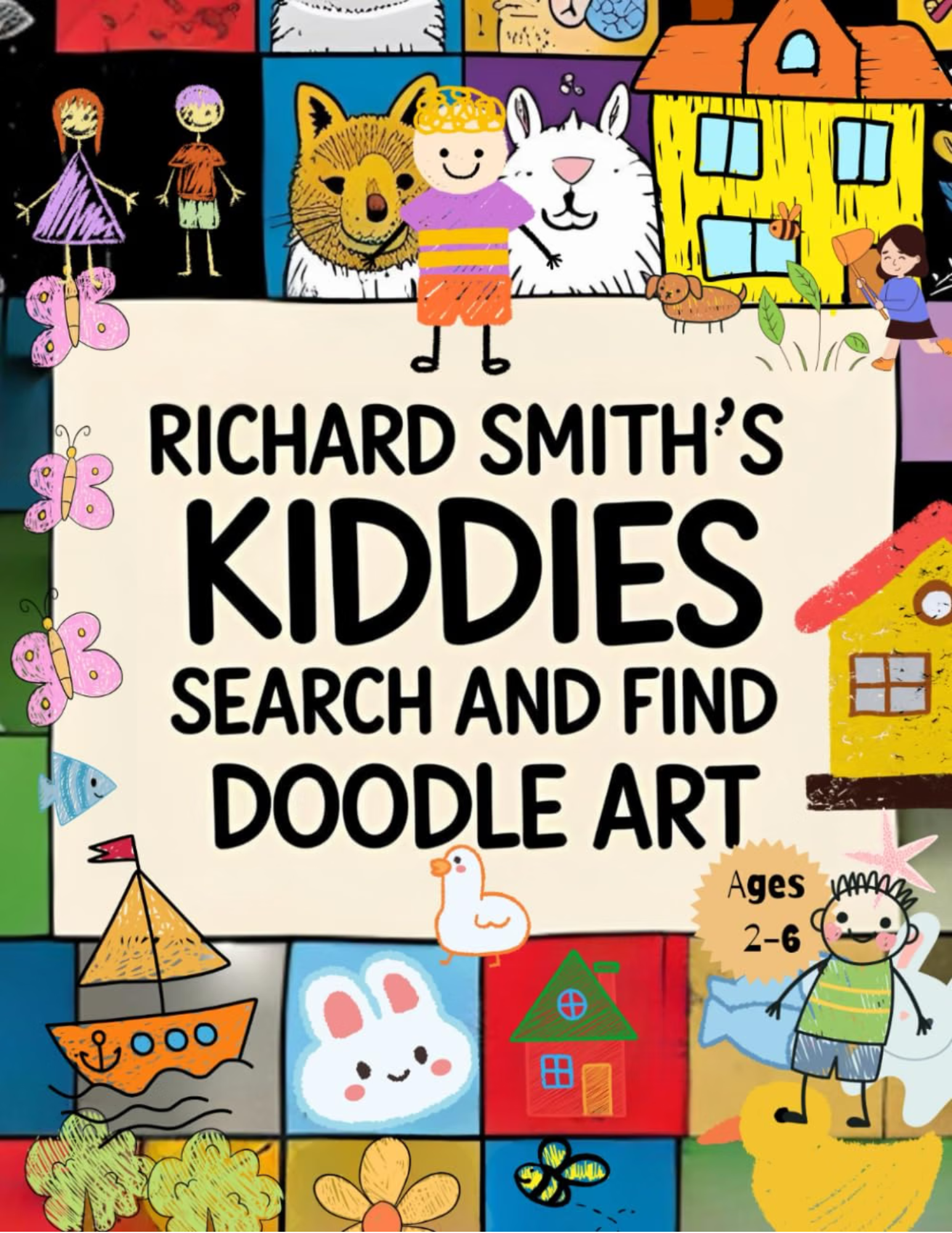
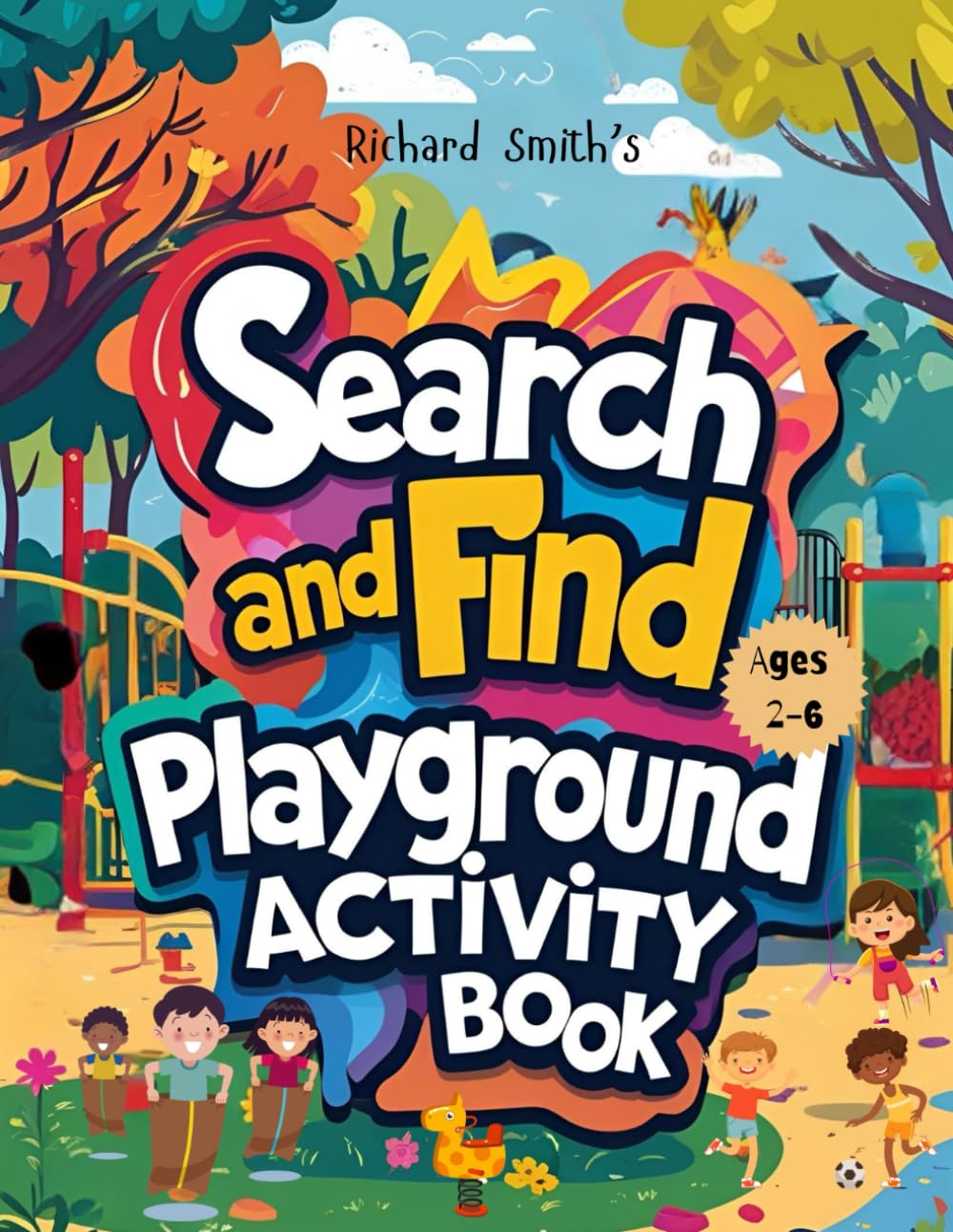
Continue the fun with one of these activity books.
1. Play a Classic I-Spy Game
Few games require less preparation than I-Spy.
Choose something visible and give your child a clue:
“I spy with my little eye something that is… blue.”
Your child scans the surroundings, considers the possibilities and starts guessing. Once they find the object, switch roles.
For younger children, colors and simple descriptions work well. As children become more confident, make the clues more interesting: something round, something beginning with B, something you can wear, or something smaller than your hand.
You can even create themed versions. In a dinosaur picture, search only for prehistoric objects. On a road trip, hunt for vehicles. At Christmas, look for ornaments, stars, presents and other festive objects.
One little game can have hundreds of variations.
2. Find the Odd One Out
Place several similar objects together and add one that is different.
For example, line up four toy cars and one dinosaur. Ask:
“Which one doesn’t belong?”
Easy.
Now make the challenge less obvious. Use four red blocks and one blue block, or several toy vehicles where only one has no wheels.
As children get better, the most interesting puzzles are those where they have to explain why something is different.
A child might even find a perfectly reasonable answer you hadn’t considered.
That’s part of the fun.
3. Create a Memory Tray Challenge
Place several familiar objects on a tray or table: perhaps a spoon, crayon, toy car, block, sock and small book.
Give your child some time to look carefully.
Then cover the objects.
How many can they remember?
For another version, secretly remove one object before uncovering the tray and ask:
“What’s missing?”
Begin with only a few objects and increase the number gradually. You can also use themed collections—only toys, only kitchen objects or a mixture designed to make the challenge trickier.
The game takes only a few minutes but can be repeated with completely different objects.
4. Solve a Maze
A maze gives children one clear mission: get from the beginning to the end.
The route, however, may not be quite so clear.
Start with simple mazes containing wide paths and only a few wrong turns. More complicated mazes can be introduced as children become comfortable planning routes and recognizing dead ends.
Themes make the challenge even more entertaining. Help a dinosaur reach its eggs, guide an astronaut back to the rocket or get a monster truck through the muddy track to the finish line.
For children who become frustrated by wrong turns, try solving the first maze with a finger before using a pencil.
No eraser required.
5. Play “What’s Missing?”
Arrange four or five toys where your child can see them.
Ask them to close their eyes.
Remove one.
When they look again, they have to identify the missing object.
Once the basic version becomes easy, rearrange the remaining objects after removing one. Now children can’t rely entirely on remembering the original positions.
Then swap roles.
Let your child remove an object while you guess.
You may want to get a few wrong deliberately. Children tend to find adults mysteriously forgetting a giant yellow toy truck extremely entertaining.
6. Try Spot the Difference
Two pictures look almost identical.
Almost.
Perhaps one dinosaur has three spots while the other has four. A cloud has disappeared. One monster truck has a different wheel, or an astronaut’s helmet has changed color.
The challenge is to examine both pictures carefully and find all the differences.
For beginners, use large, obvious changes. Older or more experienced puzzle solvers can tackle smaller differences hidden within busy scenes.
You don’t always need a prepared worksheet either. Draw two simple pictures yourself and deliberately change five details in the second one.
Then let your child create a spot-the-difference puzzle for you.
Creating the puzzle can be just as interesting as solving it.
7. Build and Continue Patterns
Grab a few everyday objects and arrange them in a repeating sequence.
For example:
🔴 🔵 🔴 🔵 🔴 ?
What comes next?
Once alternating patterns are easy, try something more complicated:
🟡 🟡 🟢 🟡 🟡 🟢 ?
Blocks, toy cars, crayons, spoons and colored paper all work.
You can also use movements instead of objects:
Clap → Stomp → Clap → Stomp → ?
The activity becomes particularly entertaining when children create patterns for adults to solve.
Don’t assume they’ll make them easy.
8. Play a Matching Pairs Memory Game
Place pairs of picture cards face down and mix them up.
Players turn over two cards at a time. If the pictures match, they keep the pair. If they don’t, the cards are turned face down again.
The challenge is remembering what you saw and where you saw it.
You can buy matching games, print picture cards or make your own with small pieces of paper. Draw pairs of simple objects such as stars, dinosaurs, trucks, apples and rockets.
For younger children, start with only a few pairs.
As their confidence grows, add more cards and watch the table become considerably more confusing.
9. Go on a Hidden-Object Hunt
Hidden-object and search-and-find puzzles transform a busy picture into a visual treasure hunt.
Give your child a scene containing many objects and a list of things to locate.
For example:
Find 3 stars, 2 dinosaurs, 1 red ball and 4 tiny footprints.
Children can point to each object, circle it or place a small mark beside the search list whenever something is found.
Themed scenes make these activities particularly engaging. A busy dinosaur world might hide eggs and fossils, while a monster truck arena could contain helmets, flags, tires and trophies.
Christmas offers even more possibilities: candy canes, stockings, bells, snowmen, presents and mischievous elves can all disappear into a festive scene.
The more carefully children look, the more they discover.
10. Try “Guess What’s in the Bag”
Place a familiar object inside a bag or pillowcase where your child cannot see it.
They can reach inside and feel the object—but they cannot take it out yet.
Ask them to describe what they notice.
Is it hard or soft? Round or flat? Smooth or rough? Does it have corners?
Then comes the big question:
“What do you think it is?”
A spoon, toy car, block, crayon, ball or small stuffed toy can all work well.
Use safe, familiar objects without sharp edges or small detachable parts.
For another version, don’t allow touching. Give verbal clues one at a time and see how quickly your child can solve the mystery.
11. Play a Simple Sorting Challenge
Gather a mixed collection of safe household objects and ask your child to sort them.
The obvious version might be sorting by color.
Then change the rule.
Sort by size.
By shape.
By what the objects are used for.
Or divide toy vehicles into cars, trucks and construction vehicles.
Once the objects are sorted, ask your child to explain the rule they used. Better still, let them invent a secret sorting rule and see whether you can work it out.
Suddenly, tidying a pile of toys has become a puzzle.
Very convenient.
12. Solve “Which Shadow Matches?”
Shadow-matching puzzles show a colorful object alongside several dark silhouettes. The child has to decide which silhouette matches the object’s exact shape.
At first glance, several shadows may look correct. Look more closely and perhaps one dinosaur has a different tail, one rocket has an extra fin or one truck has the wrong roof shape.
Encourage children to compare one feature at a time rather than trying to solve the entire shape immediately.
Check the top. Check the sides. Check the bottom.
That makes a seemingly complicated puzzle much more manageable.
You can also create a real-life version using toys and their shadows on a sunny day.
13. Try a “What Comes Next?” Picture Puzzle
Create a simple sequence and ask your child what should come next.
For example:
🚗 🚕 🚗 🚕 🚗 ?
Or:
🦖 🦖 🥚 🦖 🦖 🥚 ?
The sequence doesn’t have to involve colors or identical objects. Older children can solve patterns based on size, number or several changing features at once.
For a fun challenge, deliberately offer several possible answers and ask the child to choose the one that completes the pattern.
The important part isn’t only getting the answer.
Ask:
“How did you know?”
Explaining the pattern reveals much more about how the child solved the puzzle.
14. Create a Mini Scavenger Hunt
Hide a small object somewhere in the room and provide a sequence of clues leading to it.
For younger children, clues can be simple:
“Look somewhere we keep books.”
The next clue might lead to the sofa, toy box or dining table.
Older children can tackle riddles, picture clues or small puzzles before discovering the next location.
You can make the final treasure almost anything—a sticker, a coloring page, the child’s favorite book or simply a note announcing:
YOU SOLVED IT!
The journey is usually more exciting than the prize.
15. Make a Puzzle Challenge Box
Once you’ve tried several games, put them together into a reusable Puzzle Challenge Box.
Fill a box or jar with small challenge cards. Whenever your child wants something to do, choose one at random.
A card might say:
Find something beginning with S.
Build a red-blue-red-blue pattern.
Remember six objects.
Solve a maze.
Find five hidden stars.
Sort eight toys into two groups.
Create a riddle for someone else.
Add new challenges occasionally so the box doesn’t become predictable.
You can even include a few wonderfully silly ones, such as:
Find three things a dinosaur would probably be terrible at using.
There may not be one correct answer—and that’s exactly the point.
Choose Puzzles That Match Your Child
A good brain game should make a child think without making them feel defeated.
If a four-year-old receives an enormous maze designed for much older children, the activity may end before it begins. Likewise, a child who can instantly solve a four-piece matching game probably needs something more challenging.
Look for the sweet spot between “I already know this” and “I can’t do this.”
You can adjust many activities without replacing them completely. Add more cards to a memory game, hide more objects in an I-Spy scene, introduce smaller differences in a picture or make scavenger-hunt clues less obvious.
The same basic game can therefore grow with the child.
Give Children Time to Work Things Out
When adults can immediately see the answer, waiting can be surprisingly difficult.
There’s the hidden star.
Obviously.
Right there beside the dinosaur!
But giving the answer too quickly removes the most interesting part of the puzzle: figuring it out.
If your child is stuck, try offering a small clue rather than pointing directly to the solution.
Instead of “The star is behind the tree,” try:
“I think you should look near something green.”
That keeps the child involved in solving the problem while making the challenge manageable.
And when they finally find it, the discovery still belongs to them.
Don’t Make Every Puzzle Competitive
Competition can make some games exciting, but children don’t always need to race against a sibling, parent or clock.
A search-and-find puzzle can simply be explored. A maze can be solved without a stopwatch. A jigsaw can remain on the table until tomorrow.
Mix competitive challenges with cooperative ones.
Instead of asking “Who can find the hidden objects fastest?”, try working together to find ten objects before dinner.
Sometimes the best opponent is simply the puzzle itself.
Turn Favorite Themes Into Brain Games
The mechanics of a puzzle may be important, but the theme is often what gets a child interested in trying it.
A dinosaur fan might happily solve a maze if the mission is to help a T-Rex reach its eggs. A child who loves vehicles may spend much longer searching for hidden objects in a monster truck arena than in an unrelated picture.
The possibilities are almost endless:
| Favorite Theme | Puzzle Ideas |
|---|---|
| Dinosaurs | Mazes, hidden eggs, matching shadows, spot the difference |
| Monster Trucks | Odd truck out, I-Spy, matching, obstacle mazes |
| Ocean Animals | Hidden creatures, patterns, matching, counting |
| Farm | Animal matching, mazes, sorting, search-and-find |
| Space | Rocket mazes, alien patterns, shadow matching |
| Kawaii | Matching pairs, visual patterns, spot the difference |
| Christmas | I-Spy, hidden objects, mazes, matching, festive puzzles |
This also means a familiar puzzle can feel completely new simply by changing its world.
Search-and-Find Is a Puzzle Too
Children don’t always think of search-and-find activities as puzzles.
They’re simply hunting for things.
But a busy search-and-find scene can ask children to examine details, compare objects and keep track of what they have already discovered.
You can also layer several challenges onto the same picture.
First:
Find all 8 dinosaurs.
Then:
Which dinosaur appears only once?
Next:
How many eggs can you find?
Finally:
Can you find the tiny footprint nobody else noticed?
One illustration has suddenly become four different games.
This is one reason search-and-find activities fit so naturally alongside mazes, matching games and other puzzles in the Little Fun Lab world.
Paper Puzzles Are Great for Quiet-Time Play
Not every brain game needs to involve running around the house looking for clues.
Printable puzzles and activity books can be particularly useful when children need something quieter to do—during travel, rainy afternoons, restaurant waits or relaxed time at home.
A small activity pack might combine a maze, I-Spy challenge, spot-the-difference puzzle, matching game and hidden-object scene.
That variety matters.
If a child becomes tired of one puzzle, another type of challenge is waiting on the next page.
Add a few crayons or pencils and some puzzles can even become coloring activities after they’ve been solved.
Let Kids Create the Puzzle
Solving puzzles is fun.
Creating them introduces a completely different challenge.
Ask your child to draw a simple maze for you. Let them arrange objects for a memory test, design an odd-one-out challenge or draw two pictures containing five differences.
They can hide objects in an illustration and create a search list.
Then you have to solve it.
This changes their role from puzzle solver to puzzle designer, requiring them to think about what makes a challenge easy, difficult or perhaps hilariously impossible.
Just be prepared for a seven-year-old to insist that the microscopic star hidden behind the dinosaur’s left toenail was “really obvious.”
The Best Brain Games Don’t Feel Like Work
Children don’t need to know that a game involves memory, observation, patterns or problem-solving before they can enjoy it.
They just need an interesting challenge.
Where is the missing truck?
Which shadow belongs to the dinosaur?
How can the astronaut reach the rocket?
What comes next in the pattern?
Can you find all ten Christmas presents?
Those little mysteries provide the reason to keep looking, testing and trying again.
And that’s the wonderful thing about puzzles.
The thinking happens inside the play.
Bring More Puzzles Into Everyday Play
You don’t need a cupboard full of specialist games to get started. A few toys can become a memory challenge. Crayons can create patterns. Household objects can become an odd-one-out game, while a homemade clue can begin a scavenger hunt around the house.
Then, when you want something ready to go, printable puzzles and activity books can introduce more elaborate mazes, matching challenges, I-Spy games, hidden pictures and search-and-find adventures.
At Little Fun Lab, that’s exactly how we like our brain games:
Interesting enough to make children think.
Fun enough that they don’t notice they’re doing it.