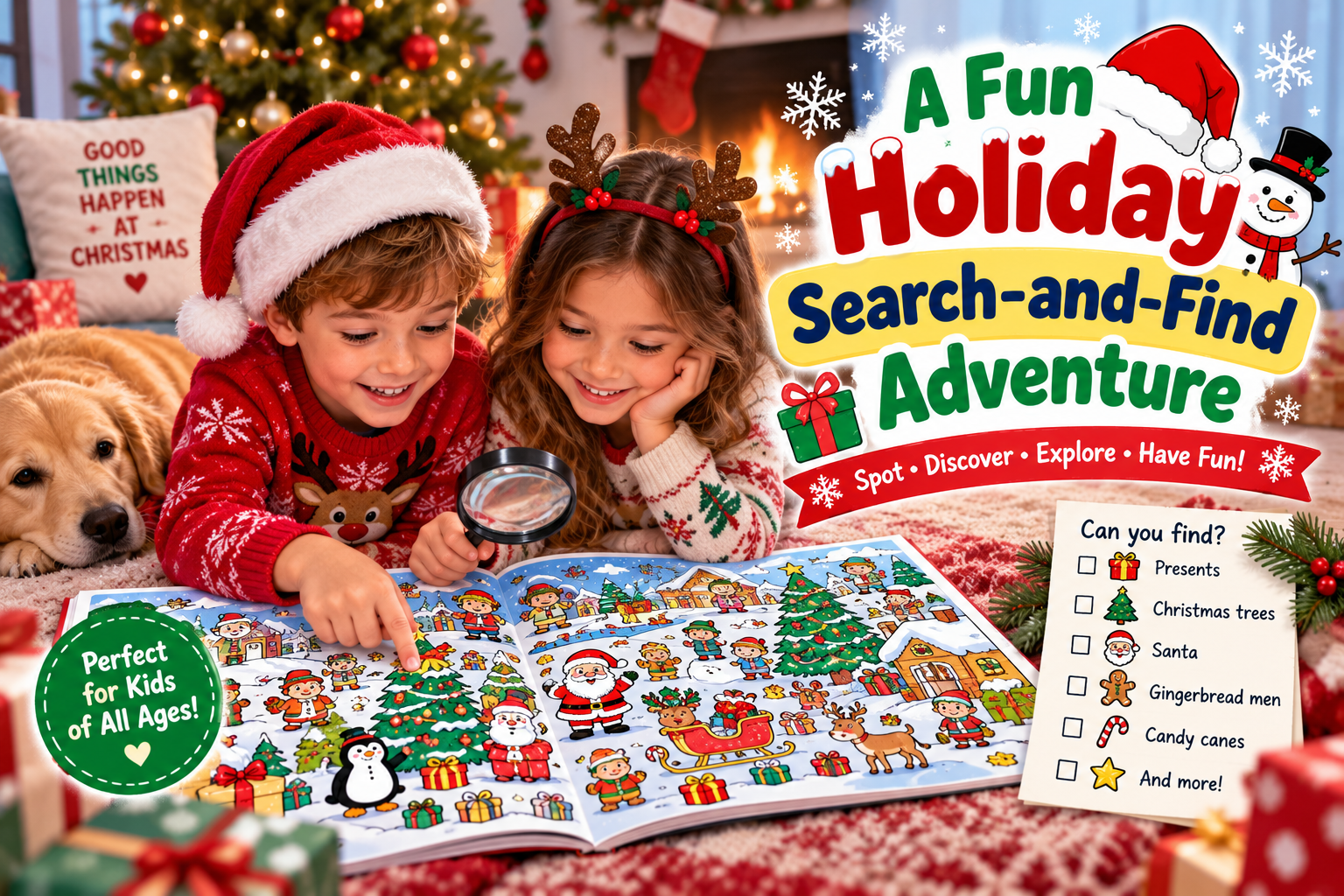
Christmas has a wonderful habit of filling the world with things children want to look at.
There are twinkling lights in windows, ornaments hanging from trees, stockings waiting to be filled, candy canes tucked into decorations and wrapped presents appearing in mysterious corners of the house. For children, the holiday season can feel like one enormous collection of things waiting to be discovered.
That makes Christmas a perfect setting for I-Spy and search-and-find activities.
Instead of simply looking at a festive picture, children receive a mission: find three snowmen, spot five candy canes, locate the tiny gingerbread man or discover the present that doesn’t match the others.
Suddenly, a Christmas scene becomes a puzzle.
And the best part? You can create Christmas I-Spy games almost anywhere—on printable activity sheets, inside activity books, around the Christmas tree, during a walk or even while waiting for dinner.
Here are plenty of ways to turn Christmas I-Spy for kids into a festive search-and-find adventure.
From the bookshelf
Recommended books
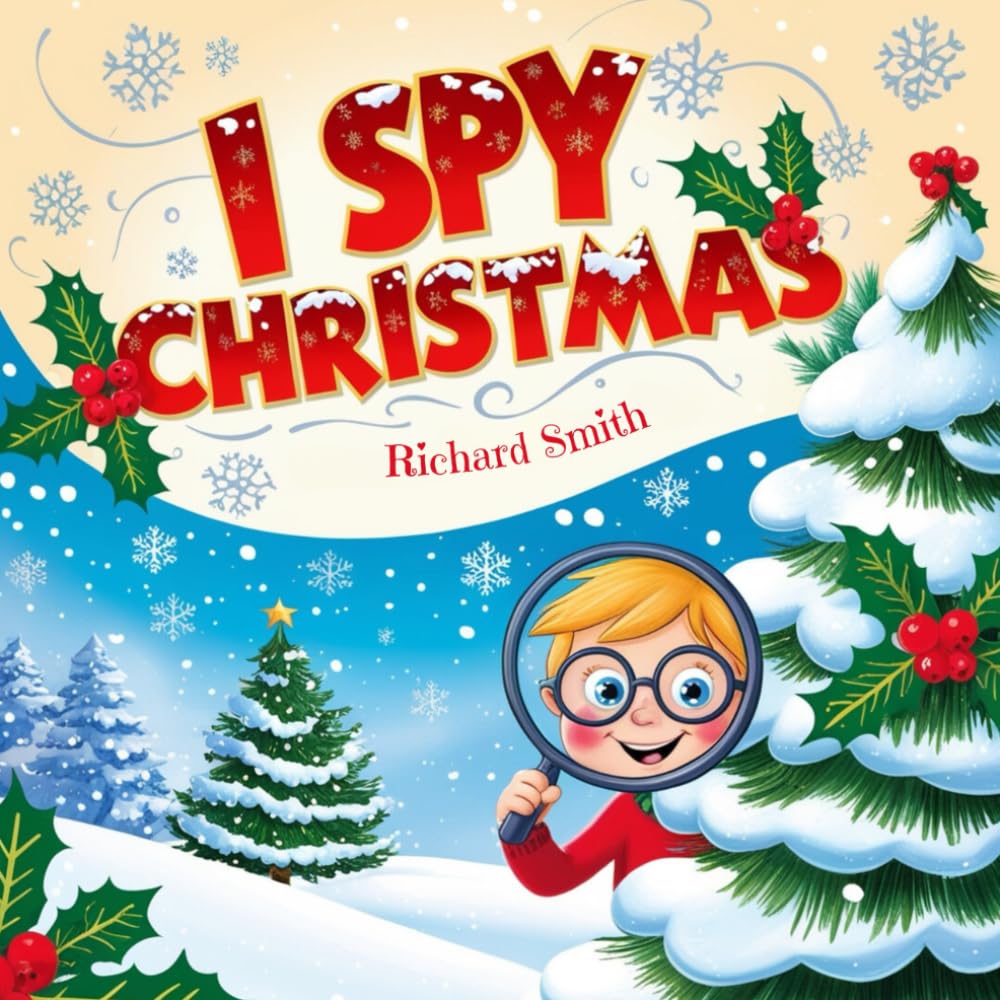
Continue the fun with one of these activity books.
What Is a Christmas I-Spy Game?
A Christmas I-Spy activity is a visual search game built around familiar holiday objects.
A child might receive a busy Christmas picture containing Santa, presents, ornaments, snowflakes, stockings, reindeer and other festive items. Alongside the picture is a list of objects to find.
For example:
Find 4 candy canes • 3 stockings • 5 stars • 2 snowmen • 1 gingerbread man
The child searches the scene and points to, circles or counts each object.
Some versions are very simple, with large objects and only a few things to find. Others contain dozens of tiny details hidden inside busy Christmas scenes.
That makes the basic idea easy to adapt for different ages and abilities.
Why Christmas Works So Well for Search-and-Find Games
A good search-and-find activity needs variety, and Christmas certainly doesn’t suffer from a shortage of recognizable objects.
Think about everything that could appear in one festive scene: presents, bells, stars, stockings, ornaments, bows, snowflakes, Christmas trees, gingerbread people, reindeer, elves, candy canes and Santa hats.
Even familiar objects can appear in different sizes, colors and positions.
One red stocking might hang from the fireplace. Another could be tucked behind a present. A tiny one might appear on an elf.
The child knows what they’re searching for, but finding every example requires a closer look.
The holiday theme adds another advantage: children already recognize many of the objects, so less time is spent explaining the activity and more time can be spent hunting.
1. Start With a Simple Christmas I-Spy Picture
For children who are new to search-and-find activities, don’t begin with a North Pole scene containing 300 objects and an elf hiding behind every snowflake.
Keep the first challenge manageable.
Choose a picture with large, clearly recognizable Christmas objects and a short search list. You might ask children to find one Santa hat, two presents, three stars and four candy canes.
Once they understand how the game works, gradually introduce busier scenes and smaller hidden objects.
The objective is to create the feeling:
“I found it!”
Not:
“I give up.”
2. Turn It Into a Christmas Counting Game
I-Spy and counting fit naturally together.
Instead of asking children to find a single Christmas tree, ask them to discover how many Christmas trees are hiding in the picture.
Try several objects:
How many presents can you find?
How many snowflakes?
How many candy canes?
How many reindeer?
Children can place a small mark beside each object as they count it or circle every example before counting the total.
For younger children, use small quantities. Older children can tackle larger collections scattered across more detailed scenes.
This transforms one Christmas picture into both a visual search and a counting activity.
3. Play Christmas I-Spy Around the Tree
You don’t need a printable for every game.
Your actual Christmas tree can become the search-and-find scene.
One person secretly chooses an ornament or decoration and gives a clue:
“I spy something shiny.”
Other clues could involve color, shape, position or size.
“I spy something red.”
“I spy something shaped like a star.”
“I spy something hanging near the top.”
If your tree contains many different decorations, the game can continue for quite a while.
For younger children, make clues obvious. For older children, combine several details: I spy something small, silver and hanging below something red.
Just keep enthusiastic little hands away from fragile ornaments while they search.
4. Hunt for Christmas Colors
A color hunt is one of the easiest Christmas I-Spy variations.
Choose a festive scene—or simply look around the room—and challenge children to find objects of a particular color.
Find five red things.
Then try green.
Gold.
White.
Or perhaps blue.
For a harder version, combine color with another characteristic:
Find something red and round.
Find something green with a star.
Find something gold that hangs.
This gives children more than one clue to consider before deciding whether an object matches.
5. Find the Odd Christmas Object
Search-and-find doesn’t always mean locating multiple hidden items.
Sometimes the mission is to find one thing that doesn’t belong.
Imagine a row of five Christmas presents. Four have red bows; one has a green bow.
Which one is different?
Or perhaps several snowmen are wearing hats, except one. Five reindeer face right while one faces left. Every Christmas tree has a star except one.
The differences can become increasingly subtle as children get better at the game.
And once they’ve solved a few, let them create an odd-one-out challenge for you.
Children tend to take enormous pleasure in making the adult version unnecessarily difficult.
6. Try a Christmas Alphabet Hunt
For children learning letters, turn I-Spy into an alphabet challenge.
Choose a letter and search for a Christmas word beginning with it.
B might lead to bell.
C could be candy cane.
E could be elf.
G might be gift or gingerbread.
You don’t need to complete the entire alphabet. Some letters require considerable Christmas imagination.
Instead, choose five or six letters and see what children can find in a picture, book or around the home.
Older children can write the words after finding them, creating a simple literacy extension to the search game.
7. Search for Santa’s Missing Things
A little story can make an ordinary search list much more exciting.
Instead of saying:
Find a hat, bell, mitten and present.
Try:
Oh no! Santa has lost some important things. Can you help him find his hat, bell, mitten and the present with the yellow bow?
The objects haven’t changed.
The mission has.
Now the child isn’t completing a list—they’re helping Santa solve a Christmas emergency.
The same idea can be adapted endlessly. An elf has misplaced the toy tools. A reindeer has lost its bell. Mrs. Claus needs help finding gingerbread cookies.
A small amount of storytelling can transform a simple puzzle.
8. Create a Christmas Scavenger Hunt at Home
Take I-Spy beyond the page by creating a short scavenger hunt.
Give children a list of Christmas-related things they need to locate around the house. Depending on your decorations, they might search for a star, Christmas card, stocking, ribbon, Santa picture, ornament or something shaped like a snowflake.
Don’t hide anything valuable, fragile or difficult to reach. The challenge should involve observation, not climbing furniture to retrieve Grandma’s glass ornament.
For younger children, use picture clues rather than written words.
Once everything has been found, children can draw or color their favorite item from the hunt.
9. Play “What’s Missing?” With Christmas Objects
Place several safe Christmas items on a table.
Perhaps you have a plastic ornament, ribbon, Christmas card, Santa hat, gift bow and candy cane.
Give your child time to look at everything.
Then ask them to close their eyes while you remove one object.
What’s missing?
Start with four or five items. Add more as the game becomes easier.
For another challenge, rearrange the remaining objects after removing one so children cannot rely entirely on remembering their positions.
Then swap roles.
Your child gets to remove something while you attempt to remember what disappeared.
10. Go on a Christmas Lights I-Spy Walk
Christmas decorations can turn an ordinary evening walk into a giant real-world search-and-find game.
Before leaving home, create a simple checklist of things you might see:
Christmas tree • Santa • reindeer • star • snowman • candy cane • presents • colorful lights
Then see how many you can spot.
You don’t need to find everything. The uncertainty is part of the adventure.
If you’re travelling by car instead, an adult passenger can manage the checklist while children look through the windows. The driver, of course, should concentrate on driving rather than hunting for inflatable snowmen.
11. Try a 60-Second Christmas Search Challenge
Once children are comfortable with I-Spy, introduce an optional timed challenge.
Choose one object in a busy Christmas scene.
How many stars can you find in 60 seconds?
When time is up, stop and count.
Then try candy canes.
Or presents.
The goal doesn’t always have to be speed, though. Some children enjoy timed challenges; others prefer searching at their own pace.
You can also make the challenge cooperative:
“Can we find all eight snowflakes together before the timer finishes?”
Now everyone is working against the clock rather than against each other.
12. Find the Tiny Christmas Surprise
Every good search-and-find scene deserves at least one object that is particularly difficult to spot.
Perhaps it’s a tiny mouse wearing a Santa hat.
A miniature gingerbread man.
A present hidden behind the Christmas tree.
Or an elf peeking through a window.
Don’t reveal where it is.
Simply add:
BONUS CHALLENGE: Can you find the tiny Christmas mouse?
Children who finish the main activity now have one final mystery to solve.
This kind of bonus object is particularly useful in activity books because it encourages children to revisit a page they think they’ve already completed.
13. Make Your Own Christmas I-Spy Page
Children don’t always have to be the puzzle solvers.
Give them a blank sheet of paper and ask them to create a busy Christmas picture containing several repeated objects.
They might draw:
5 stars
4 presents
3 candy canes
2 snowmen
1 Santa
Then someone else has to find everything.
The drawings don’t need to be perfect. In fact, slightly unpredictable child-drawn candy canes can make the adult’s search considerably more challenging.
For an extra twist, ask the child to hide one particularly tiny object somewhere in the picture.
Now they’re designing the puzzle rather than simply solving it.
14. Combine I-Spy With Coloring
A black-and-white Christmas search-and-find page can become two activities in one.
First, complete the search.
Then color the picture.
Or combine both tasks:
Find and color all the stars yellow.
Color every candy cane red.
Find three presents and give each one a different color.
This works particularly well for children who enjoy coloring but need a little more direction to get started.
It also means the activity doesn’t necessarily end when the final hidden object is discovered.
15. Build a Christmas Search-and-Find Challenge Book
If your child enjoys these games, combine several types of Christmas searches rather than repeating exactly the same puzzle.
One page might contain a classic I-Spy scene. The next could ask children to count Christmas objects, followed by an odd-one-out challenge, matching puzzle, maze or spot-the-difference activity.
This variety keeps the experience fresh.
A Christmas activity book can also be useful during school holidays, quiet afternoons, festive travel or those mysterious periods when adults are attempting to prepare Christmas dinner and children suddenly need entertainment immediately.
Keep a small box of crayons or pencils nearby and the activity is ready to go.
Make Christmas I-Spy Easier for Younger Children
Young children generally need less visual clutter and fewer search targets.
Use large, familiar objects and make the search list short. Picture clues can also work better than written lists for children who aren’t reading independently yet.
Instead of asking for ten different objects, start with three:
🎁 Find 2 presents
⭐ Find 3 stars
🍭 Find 1 candy cane
Celebrate each discovery and allow plenty of time.
If the child is struggling, give a directional clue rather than pointing directly at the answer:
“Try looking near the Christmas tree.”
That keeps the final discovery in their hands.
Make the Search Harder for Older Kids
Once simple I-Spy pages become easy, don’t abandon the game—upgrade it.
Use busier scenes, smaller objects and clues involving more than one characteristic. Instead of find a present, ask children to find the smallest present with a blue bow.
You can also introduce riddles:
I’m sweet, striped and shaped like a hook. What am I?
The child first solves the clue—candy cane—and then searches for it.
Another option is to hide several versions of the same object but make only one satisfy all the clues.
Now careful observation matters more than simply spotting something familiar.
Turn One Christmas Picture Into Several Games
One of the most useful things about a detailed search-and-find illustration is that you can reuse it.
Imagine a busy Christmas workshop filled with elves, toys, presents, candy canes, stockings and decorations.
The first time, ask children to find the objects on the official search list.
Later, use the same picture for a counting challenge:
How many elves can you see?
Next time:
Find five red things.
Then:
Which present is closest to Santa?
And finally:
Make up your own question for me to solve.
One illustration has now produced several different activities without printing another page.
Christmas I-Spy Makes a Handy Quiet-Time Activity
The weeks around Christmas can be exciting—and very busy.
There are school holidays, family visits, journeys, shopping trips and plenty of waiting while adults prepare things children have been specifically instructed not to look at.
A Christmas search-and-find activity can provide a simple screen-free option during those quieter moments.
A few printable pages and pencils fit easily into a travel folder. An activity book requires virtually no preparation. And many verbal I-Spy games require nothing at all.
That makes them useful at home, while travelling or anywhere children need a quick activity.
From Search-and-Find to Christmas Storytelling
Once all the hidden objects have been found, take another look at the picture.
What’s actually happening in the scene?
Perhaps one elf is carrying an enormous present. Where is it going? Why is a reindeer looking through the workshop window? Who left the gingerbread cookies beside Santa’s chair?
Ask your child to choose one character and tell you what happens next.
A visual puzzle has now become a storytelling prompt.
You could even write down the story and let your child illustrate another scene from it.
That’s one of our favorite things about children’s activities: one kind of play can lead naturally into another.
Create a Family Christmas I-Spy Tradition
A simple search game can also become part of your family’s Christmas routine.
Create a new I-Spy sheet every December. Play Christmas-tree I-Spy after decorating. Take the same scavenger-hunt checklist on your annual Christmas-lights walk, or let children design a puzzle for the adults on Christmas Eve.
The activity doesn’t need to be elaborate.
Sometimes traditions begin with very small things.
A few candy canes.
A hidden snowman.
And someone insisting that the tiny elf was definitely not there a minute ago.
Ready, Set… Search!
Christmas I-Spy works because the rules are simple but the possibilities are enormous.
Children can search for objects, count them, compare details, follow clues, hunt for colors or solve tiny mysteries hidden inside festive scenes. Parents can make the activity easier or harder without changing the basic game.
And Christmas provides no shortage of things to hide.
Santa hats.
Reindeer.
Snowflakes.
Gingerbread people.
Presents.
Candy canes.
Perhaps one very sneaky elf.
So whether you’re using a printable, an activity book or the decorations already around your home, give your child a mission and see what they can discover.
Look closely.
There might be more hiding in Christmas than you think.
Continue the Christmas Adventure With Little Fun Lab
For children who particularly enjoy searching through busy pictures, a full Christmas search-and-find activity book can extend the challenge beyond a single page.
Different festive scenes can take children from decorated Christmas trees and snowy adventures to Santa’s workshop, presents, reindeer and other holiday surprises—each with new objects waiting to be discovered.
Little Fun Lab’s growing collection includes a Christmas Search & Find theme, making this article a natural place to introduce the book with a cover image, a few genuine interior previews and a clear “Explore the Christmas Search & Find Book” button rather than interrupting the main article with repeated sales messages.
The article provides the ideas.
The book can provide the adventure.